
6.29.2012

6.25.2012
A Little Bit Country, A Little Bit Rock-n-Roll
 |
| The gutted Apple II+ (foreground) and Apple IIe (background). |
 |
| Keys drying on a paper towel. |
After a couple days, I reassembled the Apples and tried them out. The Apple II+ needs a new power supply. They seem reasonably priced (and more importantly available) on eBay, so I may order one up in the future. The Apple IIe booted right up with its nostalgic beep and after the pre-requisite ctrl-reset I got to the prompt.
Because the Apple OS booted from the disks, I thought I would be out of luck for awhile on playing some old games, etc. since I have only recently cleaned out and sprayed the disk drives cases, but I need to get a 5 1/4" disk cleaner to thoroughly clean the drives themselves. Then I stumbled upon this ingenious idea over at Panic Blog. The guys at Panic Blog were asked to run an old program via a cassette recorder on their office Apple IIe (yes...we used to save data on cassette tapes). Only problem was they didn't have a cassette recorder. What they did have was an iPad. They ran the program, essentially an audio file, on their iPad through their Apple IIe. Like I said....ingenious!
 |
| iPad hooked up to an Apple IIe |
After a quick Google search it turns out that someone has posted most of the old Apple programs as audio files in an online repository. (Note: For those of you without an Apple II you can play the games on a virtual machine. So, without further ado, I hooked up my iPad to the Apple IIe with a 1/8" male-male minijack cable. At the prompt on the Apple II type LOAD. Then, after pumping up the volume on my iPad I clicked on the Spy Hunter hi-fi audio. Bam....I was playing Spy Hunter.
 |
| Spy Hunter! |
5.31.2012
Short-Armed and Dangerous
In the morning hours of May 31, a crazy-assed bandicoot slaughtered a nest of baby rabbits. Eyewitnesses described the suspect as "half a dog high and two dogs long". They also reported that the screaming of the rabbits echoed through the neighborhood and for some reason they felt a longing for fava beans and a nice chianti. It was reported that the suspect was eagerly wagging a tail during the killing spree. Rescuers rushed to the scene, but by then it was too late for at least one baby bunny. The suspect was "jailed" and not given any cookies. Until his trial at the Hague, he is incarcerated in Bloomington. Of note, this maniac was also wanted for a similar incident occurring one year ago involving a baby squirrel.
 |
| “What does he do, Clarice? What is the first and principal thing he does, what need does he serve by killing? He covets. How do we begin to covet? We begin by coveting what we see every day.” |
5.07.2012
The Dead Grandmother/Exam Syndrome and the Potential Downfall Of American Society
This was originally published by Mike Adams (Biology Department, Eastern Connecticut State University) in The Connecticut Review, 1990. I feel like it needs to be updated for the newest peril of terrible amounts of the loss of printer ink on days when assignments come due.
It has long been theorized that the week prior to an exam is an extremely dangerous time for the relatives of college students. Ever since I began my teaching career, I heard vague comments, incomplete references and unfinished remarks, all alluding to the 'Dead Grandmother Problem.' Few colleagues would ever be explicit in their description of what they knew, but I quickly discovered that anyone who was involved in teaching at the college level would react to any mention of the concept. In my travels I found that a similar phenomenon is known in other countries. In England it is called the 'Graveyard Grannies' problem, in France the 'Chere Grand'mere,' while in Bulgaria it is inexplicably known as 'The Toadstool Waxing Plan' (I may have had some problems here with the translation. Since the revolution this may have changed anyway.) Although the problem may be international in scope it is here in the USA that it reaches its culmination, so it is only fitting that the first warnings emanate here also.
The basic problem can be stated very simply: A student's grandmother is far more likely to die suddenly just before the student takes an exam, than at any other time of year.
While this idea has long been a matter of conjecture or merely a part of the folklore of college teaching, I can now confirm that the phenomenon is real. For over twenty years I have collected data on this supposed relationship, and have not only confirmed what most faculty had suspected, but also found some additional aspects of this process that are of potential importance to the future of the country. The results presented in this report provide a chilling picture and should waken the profession and the general public to a serious health and sociological problem before it is too late.
As can be seen in Table 1, when no exam is imminent the family death rate per 100 students (FDR) is low and is not related to the student's grade in the class. The effect of an upcoming exam is unambiguous. The mean FDR jumps from 0.054 with no exam, to 0.574 with a mid- term, and to 1.042 with a final, representing increases of 10 fold and 19 fold respectively.

Figure 1 shows that the changes are strongly grade dependent, with correlation coefficients of 0.974 for mid-terms and 0.988 for finals. Overall, a student who is failing a class and has a final coming up is more than 50 times more likely to lose a family member than an A student not facing any exams.
Only one conclusion can be drawn from these data. Family members literally worry themselves to death over the outcome of their relatives' performance on each exam. Naturally, the worse the student's record is, and the more important the exam, the more the family worries; and it is the ensuing tension that presumably causes premature death. Since such behavior is most likely to result in high blood pressure, leading to stroke and heart attacks, this would also explain why these deaths seem to occur so suddenly, with no warning and usually immediately prior to the exam. It might also explain the disproportionate number of grandmothers in the victim pool, since they are more likely to be susceptible to strokes. This explanation, however, does not explain why grandfathers are seldom affected, and clearly there are other factors involved that have not been identified. Nonetheless, there is considerable comfort to be had in realizing that these results indicate that the American family is obviously still close-knit and deeply concerned about the welfare of individual members, perhaps too much so. As some colleagues have expressed some degree of skepticism over my interpretation of these data, I have extended the scope of my research into the phenomenon. Using readily available sources (including the National Census Bureau and The National Enquirer ) have examined the relationship between education and family structure. Interestingly, there appears to be no correlation between FDR and the size of the extended family (Table 2). Either large families worry less on a per capita basis than do small families, or there is a single "designated worrier" in each family, who bears the brunt of the danger. The exceptionally high death rate among grandmothers (24 times greater than for grand fathers) suggests the latter explanation is correct. If not, then people from very small families would be well advised to discourage other family members from attending college, since the potential risk becomes excessive with so few members to share the danger.

The problem is clearly far more pervasive than most people realize. For example, if one examines the percentage of the population attending college and the mean divorce rate on a country by country basis, there is a very strong positive correlation between the two. The United States has the highest percentage of its population attending college and also the world's highest divorce rate, while South Yemen is last in both categories. Although this study is still in progress and will form the basis for a future CSU grant proposal, it seems results already are becoming clear. As more people go to college, their families find that, for safety reasons, it is wise to increase the number of grandmothers per family. Since there is currently no biological way of doing so (though another grant proposal in preparation will ask for funds to look into the prospect of cloning grandmothers, using modern genetic engineering techniques), the families must resort to in creasing the pool by divorce and remarriage. Sociologists may wish to use these data to examine the effect of education on family structure from a new perspective.
While the general facts of this problem have been known, if not widely discussed, I have recently become aware of a potentially far more dangerous aspect of the whole process. This trend came to light when a student reported two family members dying prior to an exam. Examination of the numbers of deaths over the last two decades clearly showed a "death inflation" When the figures for all students and all exams are pooled for each year, a disturbing outcome is seen (see Figure 2).
The FDR is climbing at an accelerating rate. Extrapolation of this curve suggests that 100 years from now the FDR will stand at 644/100 students/exam. At that rate only the largest families would survive even the first semester of a student's college career. Clearly something will have to be done to reverse this trend before the entire country is depopulated. Three possible solutions come to mind:
It has long been theorized that the week prior to an exam is an extremely dangerous time for the relatives of college students. Ever since I began my teaching career, I heard vague comments, incomplete references and unfinished remarks, all alluding to the 'Dead Grandmother Problem.' Few colleagues would ever be explicit in their description of what they knew, but I quickly discovered that anyone who was involved in teaching at the college level would react to any mention of the concept. In my travels I found that a similar phenomenon is known in other countries. In England it is called the 'Graveyard Grannies' problem, in France the 'Chere Grand'mere,' while in Bulgaria it is inexplicably known as 'The Toadstool Waxing Plan' (I may have had some problems here with the translation. Since the revolution this may have changed anyway.) Although the problem may be international in scope it is here in the USA that it reaches its culmination, so it is only fitting that the first warnings emanate here also.
The basic problem can be stated very simply: A student's grandmother is far more likely to die suddenly just before the student takes an exam, than at any other time of year.
While this idea has long been a matter of conjecture or merely a part of the folklore of college teaching, I can now confirm that the phenomenon is real. For over twenty years I have collected data on this supposed relationship, and have not only confirmed what most faculty had suspected, but also found some additional aspects of this process that are of potential importance to the future of the country. The results presented in this report provide a chilling picture and should waken the profession and the general public to a serious health and sociological problem before it is too late.
As can be seen in Table 1, when no exam is imminent the family death rate per 100 students (FDR) is low and is not related to the student's grade in the class. The effect of an upcoming exam is unambiguous. The mean FDR jumps from 0.054 with no exam, to 0.574 with a mid- term, and to 1.042 with a final, representing increases of 10 fold and 19 fold respectively.

Figure 1 shows that the changes are strongly grade dependent, with correlation coefficients of 0.974 for mid-terms and 0.988 for finals. Overall, a student who is failing a class and has a final coming up is more than 50 times more likely to lose a family member than an A student not facing any exams.
 |
| Figure 1. Graph of data in Table 1, showing the relationship between exam, student grade and FDR. The proportion of explained variance is also provided. |
Only one conclusion can be drawn from these data. Family members literally worry themselves to death over the outcome of their relatives' performance on each exam. Naturally, the worse the student's record is, and the more important the exam, the more the family worries; and it is the ensuing tension that presumably causes premature death. Since such behavior is most likely to result in high blood pressure, leading to stroke and heart attacks, this would also explain why these deaths seem to occur so suddenly, with no warning and usually immediately prior to the exam. It might also explain the disproportionate number of grandmothers in the victim pool, since they are more likely to be susceptible to strokes. This explanation, however, does not explain why grandfathers are seldom affected, and clearly there are other factors involved that have not been identified. Nonetheless, there is considerable comfort to be had in realizing that these results indicate that the American family is obviously still close-knit and deeply concerned about the welfare of individual members, perhaps too much so. As some colleagues have expressed some degree of skepticism over my interpretation of these data, I have extended the scope of my research into the phenomenon. Using readily available sources (including the National Census Bureau and The National Enquirer ) have examined the relationship between education and family structure. Interestingly, there appears to be no correlation between FDR and the size of the extended family (Table 2). Either large families worry less on a per capita basis than do small families, or there is a single "designated worrier" in each family, who bears the brunt of the danger. The exceptionally high death rate among grandmothers (24 times greater than for grand fathers) suggests the latter explanation is correct. If not, then people from very small families would be well advised to discourage other family members from attending college, since the potential risk becomes excessive with so few members to share the danger.

The problem is clearly far more pervasive than most people realize. For example, if one examines the percentage of the population attending college and the mean divorce rate on a country by country basis, there is a very strong positive correlation between the two. The United States has the highest percentage of its population attending college and also the world's highest divorce rate, while South Yemen is last in both categories. Although this study is still in progress and will form the basis for a future CSU grant proposal, it seems results already are becoming clear. As more people go to college, their families find that, for safety reasons, it is wise to increase the number of grandmothers per family. Since there is currently no biological way of doing so (though another grant proposal in preparation will ask for funds to look into the prospect of cloning grandmothers, using modern genetic engineering techniques), the families must resort to in creasing the pool by divorce and remarriage. Sociologists may wish to use these data to examine the effect of education on family structure from a new perspective.
 |
| Figure 2: The mean FDR/100 students for all exams and all grades of students for the years 1968-1990. The best fitting curve shows an exponentially rising curve. |
While the general facts of this problem have been known, if not widely discussed, I have recently become aware of a potentially far more dangerous aspect of the whole process. This trend came to light when a student reported two family members dying prior to an exam. Examination of the numbers of deaths over the last two decades clearly showed a "death inflation" When the figures for all students and all exams are pooled for each year, a disturbing outcome is seen (see Figure 2).
The FDR is climbing at an accelerating rate. Extrapolation of this curve suggests that 100 years from now the FDR will stand at 644/100 students/exam. At that rate only the largest families would survive even the first semester of a student's college career. Clearly something will have to be done to reverse this trend before the entire country is depopulated. Three possible solutions come to mind:
- Stop giving exams. At first glance, this seems to be the simplest answer to the problem. Like many simplistic solutions, however, it fails to consider the full ramifications of such a course. Without exam results, all medical schools would be forced to close their doors, having no way of distinguishing worthy students. The resultant dearth of physicians in the next generation would throw so many other professionals (tax accountants, malpractice attorneys, golf pros, etc.) out of work that the economy would go into a nosedive. Regretfully, this solution must be abandoned since it is more dangerous than the original problem.
- Allow only orphans to enroll at universities. This is an extremely attractive idea, except for the shortage of orphans. More could be created of course, but this would be morally wrong, and in any case would replicate the very problem we are trying to avoid i.e. excessive family deaths.
- Have students lie to their families. Students must never let any of their relatives know that they are at university. (Initial field tests show that keeping just the grandmother ignorant is neither feasible nor safe for the rest of the family.) It is not enough merely to lie about exams; if the family doesn't know when the exams are, they may then worry constantly and this may lead to even higher death rates. The only solution is that the family must never be aware that the student is even enrolled at a university. Students must pretend they are in the armed forces, have joined some religious cult, or have been kidnapped by aliens. All of these alternate explanations for their long absences will keep the family ignorant of the true, dangerous, fact. Although it might be argued that such large-scale deceptions could not be maintained for long periods, the success of many politicians suggests otherwise.
A Guide for Teaching Mathematics
The first time I saw this guide I laughed so hard I choked. I cam across it in about 1993 at http://bearspace.baylor.edu/Alexander_Pruss/www/teachmath.html. It has been my Robert's Rules, my Strunk and White, my HG2G ever since. The initial introduction is as follows:
It is the responsibility of the teacher to actively involve his or her students in the learning process. The most important thing he or she should do is to avoid giving clear, concise, organized lectures. If the presentation of a lesson is too easy to follow, most of the class will not need to learn the new material on their own. They will have a certain degree of confidence in their new knowledge, and this will tend to stifle their intellectual pursuits. If, on the other hand, the lecture is vague, rambling and disorganized, the students will leave with their heads full of questions. In fact, they will be so filled with curiosity that they will try to expand their knowledge on their own. There are many ways to present a thought provoking lecture. One of the easiest techniques to use is a foreign accent. If the accent is thick enough, even a well organized lecture will produce expressions of intellectual wonder among the students. Effective accents can be acquired in Alabama, China, India, Latin America, New York City, Germany, or any foreign country.
For natives of Kansas, that is, for individuals who cannot speak anything but perfect Midwestern English, this technique may offer difficulties. There are two possible solutions: (1) One can teach in a foreign country, or at least in New York or Texas; or (2) One can incorporate a new syllable into one's language. Two very effective syllables to use are 'um' and 'uh'. The chosen syllable should be uttered every second or third word. This reduces the possibility that any coherent concept will be given to the class. For example, one can say, "Um, today, um, we will be, um, discussing, um....um, determinants." After a couple of sentences, most of the class will be staring at their watches or out the windows. Very quickly, they will become very anxious to go out and learn the material on their own.
In addition, to being aware of one's own speech patterns, the teacher should also pay close attention to the written word. Effective use of the blackboard should be considered almost a necessity. Illegible handwriting can stimulate a student's interest in new material almost as effectively as Incoherent lectures. Often students will meet outside of class to exchange interpretations of lecture notes. Thus illegible handwriting encourages students to work together and share ideas. Writing illegibly requires a great deal of practice to be effective. If one does not have satisfactory handwriting (that is to say., if one's handwriting is suitable only for formal invitations and eye charts). certain "tricks" can be learned:
I found this text stuck on the door when I moved into my office as a graduate student at the University of British Columbia's Mathematics Department. The text consisted of four pages, typewritten, numbered 449–452, of which you can see pictures here. I do not know the source. The heading and the text at the end are scanned in from the yellowing pages of the original, and the text at the end suggests that what I have must have appeared in some publication, but the editors do not know the original author. Actually, my suspicion is that the original text may have ended with the paragraph starting with the words "There is one last point on teaching technique", since that paragraph would be a natural stopping point. The rest of the text starting with "The first section of this guide has dealt with actual teaching" might well, thus, be by another author.
It is the responsibility of the teacher to actively involve his or her students in the learning process. The most important thing he or she should do is to avoid giving clear, concise, organized lectures. If the presentation of a lesson is too easy to follow, most of the class will not need to learn the new material on their own. They will have a certain degree of confidence in their new knowledge, and this will tend to stifle their intellectual pursuits. If, on the other hand, the lecture is vague, rambling and disorganized, the students will leave with their heads full of questions. In fact, they will be so filled with curiosity that they will try to expand their knowledge on their own. There are many ways to present a thought provoking lecture. One of the easiest techniques to use is a foreign accent. If the accent is thick enough, even a well organized lecture will produce expressions of intellectual wonder among the students. Effective accents can be acquired in Alabama, China, India, Latin America, New York City, Germany, or any foreign country.
For natives of Kansas, that is, for individuals who cannot speak anything but perfect Midwestern English, this technique may offer difficulties. There are two possible solutions: (1) One can teach in a foreign country, or at least in New York or Texas; or (2) One can incorporate a new syllable into one's language. Two very effective syllables to use are 'um' and 'uh'. The chosen syllable should be uttered every second or third word. This reduces the possibility that any coherent concept will be given to the class. For example, one can say, "Um, today, um, we will be, um, discussing, um....um, determinants." After a couple of sentences, most of the class will be staring at their watches or out the windows. Very quickly, they will become very anxious to go out and learn the material on their own.
In addition, to being aware of one's own speech patterns, the teacher should also pay close attention to the written word. Effective use of the blackboard should be considered almost a necessity. Illegible handwriting can stimulate a student's interest in new material almost as effectively as Incoherent lectures. Often students will meet outside of class to exchange interpretations of lecture notes. Thus illegible handwriting encourages students to work together and share ideas. Writing illegibly requires a great deal of practice to be effective. If one does not have satisfactory handwriting (that is to say., if one's handwriting is suitable only for formal invitations and eye charts). certain "tricks" can be learned:
- Write small. For students in the back rows, this is almost as effective as writing illegibly. The disadvantage is that students in the front rows will probably be able to read the board and may possibly learn something without having to spend hours interpreting their notes. Also, the professor who writes small may find that most of his or her class will try to sit near the front of the room, which may be too close for comfort, especially on hot days during summer sessions.
- Write fast. The faster the teacher writes, the faster the students will have to take notes. Often the teacher can move on to a new subject while his or her students are still trying to copy what is on the board . Students will be so busy during class that they will wait until after class to try to understand the lesson. In addition to spurring students to learn on their own, writing fast allows the professor to cover more material in a given class period.
- Write something while saying something different. For example, after working out a lengthy problem the instructor tells the class the answer; is x2 + y while writing on the board y2 + x. This forces students to rethink the problem in order to decide which alternative is correct. Students are thus actively involved in problem solving even after the problem is finished.
- Erase quickly. This technique practically forces those members of the class who take notes to pay constant attention to the lectures. Those who doze off for a few moments will awaken to find nothing to record in their notes on the topics they missed. This technique is especially effective if one uses both hands to write and erase simultaneously. If all else fails, stand in front of what has just been written. By blocking any clear view of the blackboard, the teacher will help improve students' speculative and psychic abilities. Those instructors who are short or underweight may find this procedure extremely difficult. The above 'tricks' may be used separately or combined. It is a good idea to change them occasionally in order to add some variety to the classroom routine.
There is one last point on teaching technique. It is important that one does not overprepare for lectures. Generally, one should arrive at class a few minutes early, open the book, and glance at the topic for that particular day. Lectures prepared in this manner have a certain freshness and spontaneity that is often missing from those which are more carefully organized. In addition, students will gain a greater appreciation for a correct proof if they see how much time can be spent on a wrong approach.
The first section of this guide has dealt with actual teaching, concentrating on lecturing 'tricks', techniques, and preparation. The subject of the last part will be general appearances. Students tend to have more confidence in an instructor if they believe he or she has a thorough understanding of his or her field. To show a class that one has a thorough understanding of mathematics, it is necessary to appear 'spaced-out.' Being 'spaced-out' implies one is so involved with abstract mathematics that one has lost touch with the real world. There are several ways to project such an image.
- Dress funny. Old suits, baggy pants, narrow ties, and hairy sweaters are all effective and even more so, when worn together.
- Don't wash your sweatshirts. Albert Einstein is best remembered for two things—being a genius and wearing dirty sweatshirts. Even if you are not a genius, you can still wear the sweatshirts. In a matter of weeks, you will gain such a reputation that no one will come near enough to challenge it.
- Don't comb your hair with anything finer than your left hand.
- Walk into the wrong room and begin to lecture to whatever class is in it. (This will help spread your reputation beyond your own students).
- Walk into the correct classroom and begin lecturing on whatever happens to be left on the blackboard from the previous class.
- Acquire a facial twitch.
- Pretend you are deaf if someone asks a question or the bell rings while you are lecturing. Try to keep talking after everyone has left the room.
- Follow all the guidelines for teaching given above.
5.03.2012
Lionel Richie Challenge Announced at Data Fest 2012

Eight teams and 30 UCLA undergraduate students competed in the first DataFest, held in the Ackerman Conference Rooms on May 6 through May 8. Lieutenant Thomas Zak, Officer-in-Charge of the Los Angeles Police Department Strategic Crime Analysis Section, challenged students to analyze five years of crime report data to determine whether any discovered associations suggest policy changes to increase safety in Los Angeles.
This year Wiley donated two copies of my book, Comparing Groups, as prizes for Data Fest. I think that is pretty cool. Props to Wiley, although I suspect that they are trying to clear out shelf space. Rob asked me what students should have to do to earn them, so I suggested anything he felt, but if it involved Lionel Richie it would just be icing on the cake. This is when he announced to me that whatever it involved, it would be referred to as the Lionel Richie Challenge
Note to Rob: I will come out a judge for you in the future. This is such a great idea! I am going to try and convince the statistics department at Minnesota that they want to be involved in this as well.
Do you remember this?
This was the entire subject line and body of the email message I received a couple days ago from my sister. She had attached the following picture taken over the holidays several years ago. I had sat in a chair to read a book. Apparently not a really good chair as it collapsed and I sprawled to the floor. Sandra immediately snapped a picture and we all had a good laugh.


Check out the yellow/green shag carpet at our parents place!! The adjacent room had orange/red shag! Awesome!!!!
4.30.2012
Plotting Symbols, Line Types and Colors in R
When using R, there are 657 named colors, 25 named plotting characters, and 6 named line types. How is a person supposed to remember what they are? I can't, which often results in trial and error in finding something to plot reasonably. Jason Bryer has put together some useful plots, based on previous work by John Mount, for easing the cognitive burden associated with remembering these items. The plots are shown below. The R code to create these directly in R is presented on Jason's website.
 |
| Twenty-five named plotting characters in R. For example, pch=16 will plot using filled-in circles. |
 |
| Six hundred fifty-seven named colors in R. For example, col=657 will use the color "yellow green". Use colors() to see the actual color names. |
 |
| Six named line types in R. For example, lty=2 will plot using a dashed line. |
4.26.2012
Twins `Improvement'
Have the Twins improved this year? Perhaps. Joe Mauer looks better (hard not to though to be fair). Compare the spraycharts for games at Target Field for 2011 (left) and 2012 (right). The red dots show outs and the blue dots show hits (dots are sized to indicate whether the hit is a single, double, triple, or homerun.


Josh Willingham is the bomb.


Wow! Even a homerun in 2012! Way to go Joe. Most of his outs are still in the infield and left field. As he himself pointed out, he needs to pull more pitches to right. How about Justin Morneau–Canadian Wonderlad?


Justin doesn't pull the ball much at all...at least not with any power. He does seem to be hitting with a little more power in general this year (at least the balls are, in general, going further from home plate).

4.09.2012
My Feelings Exactly
In a recent issue of Forbes, Larry Downes points out the reasons that he believes that Best Buy is going to gradually go out of business [read article]. I have made this point repeatedly to almost anyone that will listen, generally after I have just visited a Best Buy retail store. Downes, who undoubtedly wrote the article after going to Best Buy writes,
Me: Can you direct me to the section in your store in which I might find audio cables.
Best Buy Guy: Well....why do you need them.
Me: I need to hook my home audio/video Mac up to a digital receiver. (in head I am instantly regretting imparting this information)
BBG: You can't do what you want to do.
Me: Yes you can.
BBG: Well maybe with a $300 box.
Me: You don't need that. Where are your cables?
BBG: You will definitely need Monster cables.
Me: %#$$Q*&#%&
My friend Tom says that Best Buy is needed for people like his mom who are too scared of MicroCenter. While I kind of agree with his point, the people at MicroCenter are actually quite helpful even for folks like Tom's mom (and my mom). Even more accessible are the good folks at Apple. These samaritans spend several hours working in small groups with people who make my sister look like she is a techno-genius. So, if Best Buy fails, someone will be there to pick up the slack.
To discover the real reasons behind the company’s decline, just take this simple test. Walk into one of the company’s retail locations or shop online. And try, really try, not to lose your temper.There is no better place to lose your cool than inside of this craphole. My latest trip there (why did I go again..I never fail to amaze myself at how much I want something to change) resulted in the following exchange:
Me: Can you direct me to the section in your store in which I might find audio cables.
Best Buy Guy: Well....why do you need them.
Me: I need to hook my home audio/video Mac up to a digital receiver. (in head I am instantly regretting imparting this information)
BBG: You can't do what you want to do.
Me: Yes you can.
BBG: Well maybe with a $300 box.
Me: You don't need that. Where are your cables?
BBG: You will definitely need Monster cables.
Me: %#$$Q*&#%&
My friend Tom says that Best Buy is needed for people like his mom who are too scared of MicroCenter. While I kind of agree with his point, the people at MicroCenter are actually quite helpful even for folks like Tom's mom (and my mom). Even more accessible are the good folks at Apple. These samaritans spend several hours working in small groups with people who make my sister look like she is a techno-genius. So, if Best Buy fails, someone will be there to pick up the slack.
3.26.2012
Scientific Writing

Scientific papers must begin with an obligatory nod to their own relevance, usually by citing exaggerated figures about disease prevalence or other impending disasters. If your research does not actually address one of these issues, pretend it does, because hey, that didn’t stop you on the grant application. For example, you might write, “Twenty million children die of scabies every day. OMG we built a robot kangaroo!”and,
Remember your audience. It consists primarily of graduate students who, 10 years from now, will include your paper in their own voluminous collection of superscripted references. So remember them, and make your name easy to spell.Check out the entire article for much more advice.
3.25.2012
Some Miscellany
I saw a blog post that had gifts for data geeks. Most ideas were not that cool, but a couple were. One featured a wall clock from Fluid Forms. The clock is created by etching an OpenStreets Map into acrylic or wood. Below is a screen shot I took of one I created from a map of Minneapolis. The hands emanate from Nicollet Island.
 They also make necklaces, earrings, etc. But, the minimum order is 60 pieces. I need to talk some shop into ordering them so I can buy a necklace.
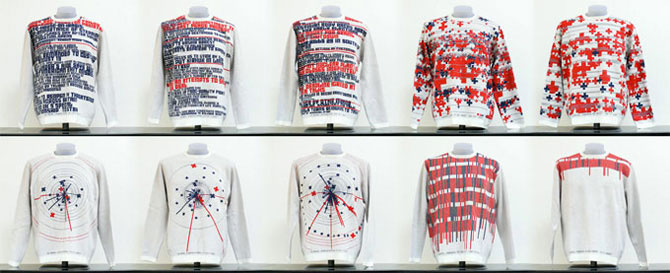
The other cool gift, was from a project called Newsknitter. This project produces sweaters based on 24 hours of new feed from the Internet. Good looking, warming and surely a topic the wearer has to explain more than once.


The other cool gift, was from a project called Newsknitter. This project produces sweaters based on 24 hours of new feed from the Internet. Good looking, warming and surely a topic the wearer has to explain more than once.
3.17.2012
Some Word Clouds
I was dorking around with R today and decided to create some Word clouds. The first is of the 2012 State of the University Address given by President Kaler on March 1, 2012. After removing punctuation (except for hyphens), numbers, converting everything to lowercase, and stripping whitespace, I used the tm package to create a document-term matrix (recording each word along with its frequency). After converting this to a data frame, I used the brewer.pal() and wordcloud() functions to create the word cloud itself.

The result shows that President Kaler used all of the appropriate terms one would expect in a State of the University Address. The terms "students", "faculty, and "research" are all prominent, as are "budget", "tuition", balancing", "support" and "learning" and other administrative catch-all words.
The code I used was
The second word cloud is based on my Google Scholar page. The cloud on the left-hand side shows my co-authors (sized by most frequent) and the cloud on the right-hand side shows terms that show up in the work linked to my Scholar page.
 The summary citation info can also be output in R. Mine is
The code is below

The result shows that President Kaler used all of the appropriate terms one would expect in a State of the University Address. The terms "students", "faculty, and "research" are all prominent, as are "budget", "tuition", balancing", "support" and "learning" and other administrative catch-all words.
The code I used was
library(tm)
library(wordcloud)

## Read in the data from a folder which contains the text document(s)
(ovid <- Corpus(DirSource("/Users/andrewz/Documents/Data/State-of-the-University/"),
    readerControl = list(reader = readPlain)))

## Document preparation
sotu <- tm_map(ovid, removePunctuation, preserve_intra_word_dashes = TRUE)
sotu <- tm_map(sotu, removeNumbers)
sotu <- tm_map(sotu, tolower)
sotu <- tm_map(sotu, stripWhitespace)
sotu <- tm_map(sotu, removeWords, stopwords("english"))
sotu <- tm_map(sotu, stripWhitespace)

## Create document-term matrix
tdm <- DocumentTermMatrix(sotu)
m <- as.matrix(tdm)
v <- sort(colSums(m),decreasing = TRUE)
d <- data.frame(word = names(v), freq = v)

## Plot
pal <- brewer.pal(7, "Set3")
pdf("/Users/andrewz/Desktop/SOTU.pdf", width = 8.33, height = 6.67, bg = "black")
wordcloud(d$word,d$freq,
 #scale=c(8, 0.3),
 min.freq = 3,
 #max.words = 100,
 #random.order = TRUE,
 rot.per = 0.15,
 colors = pal,
 vfont=c("sans serif","plain")
 )
dev.off()
The second word cloud is based on my Google Scholar page. The cloud on the left-hand side shows my co-authors (sized by most frequent) and the cloud on the right-hand side shows terms that show up in the work linked to my Scholar page.

Total papers = 20
Median citations per paper = 1.5
Median (citations / # of authors) per paper = 0.4166667
H-index = 6
G-index = 9
M-index = 1
First author H-index = 4
Last author H-index = 2
First or last author H-index = 5
First or second author H-index = 5
The code is below
source("http://biostat.jhsph.edu/~jleek/code/googleCite.r")
out <- googleCite("http://scholar.google.com/citations?user=cWpN_s8AAAAJ&hl=en",
    pdfname = "/Users/andrewz/Desktop/Zieffler_wordcloud.pdf")
gcSummary(out)
3.13.2012


3.12.2012
USC Football
This one goes out to Jeff.


Really Utah and Colorado don't have enough data to support the smoother, but they are there for completeness. I took off the confidence envelopes so they wouldn't distract from the story.
3.09.2012
Digital Scrapbook: Teaching
This editorial was written by Rob Gardner, our Knowledge Bowl coach my senior year. It appeared in the St. Cloud Times and I believe almost any teacher (rookie or seasoned) can relate to its sentiment.
Teachers Make Lasting Mark on Students
I recently attended a pair of high school graduation ceremonies. I knew several graduating seniors and wanted to show my support for them and wish them luck in their futures-standard commencement fare.
But in the process of affirming these students' abilities and accomplishments, I also affirmed one of the most important decisions of my life: to become a teacher.
I recently finished my third year of college and my third year of studying to be a teacher. College and its requisite decisions have not always been easy. After my first year I changed my field of emphasis...; I didn't want to risk facing students and not being enthusiastic: If I couldn't enjoy the subject, I could never expect my students to. Luckily, others do not feel the same about this area.
So I changed my emphasis-and my outlook. Since then, things have gone well. Until spring quarter.
I had an education class with field experience. For the first time since I decided on my new major, I was put into the classroom for an extended period of time (eight weeks!) to observe, to practice and to learn.
And learn I did. I learned from one class how wonderful discussions can be and how willing students are to expand their worlds of knowledge and experience. I learned to treat all students as equals: to do anything less is to invalidate their worth. And I learned never to lower my expectations because students will match their teacher's expectations, whether high or low.
But then I moved to a different school and different students and had these lessons put to the test. I met the challenge and, two weeks later, felt nearly everything I had done. had gone awry. I began to doubt my decision to be a teacher.
How could two short weeks have such an impact? So much happens in so little time. Reactions quickly add up.
After this class ended, I'd have time to recover and regroup before I student teach, I reasoned. But deep down I knew I would not approach teaching the next time with the enthusiasm and openness that I had at the beginning of my field experience. I had my first battle scars, and I was reluctant to risk getting more.
Then came graduation. Though I graduated from high school only three years ago, I had already forgotten how students and teachers react commencement day. Even if I did remember, it would have been from a student perspective which, though joyous in its own right,is naturally limited.
I was lucky enough to view the Apollo commencement from "behind the scenes" as everyone prepared to go through the ceremonies. I saw, as teachers arrived, graduates rush up to them for one last hug or handshake. I saw seniors and teachers crack one last joke together. And I saw the tears begin to well up in almost everyone's eyes-including mine. During the ceremony I heard teachers whisper to each other about the students' qualities as the students received their diplomas.
After the ceremony the tears again began to form as the graduates emerged from Hallenbeck Hall. But this time the tears were mixed with surprise and happiness as former graduates-former students-picked their way through the crowd to say hello to their former teachers. Quickly, what once looked like the end of so many relationships became a reunion and renewal.
And that's exactly when I too felt renewed. In this instant I realized the real reason I want to be a teacher: While subject. matter (and my interest in it) is important, the impact I can have on students' lives, the dependable relationships I can build with students and the motivation I can give them far excel any other reasons for me to become a teacher.
Why do I want to be a teacher? Simply put, to work with students, all of whom are extraordinary.
Robert Gardner is majoring in English and secondary education at St. Cloud State University.
Teachers Make Lasting Mark on Students
I recently attended a pair of high school graduation ceremonies. I knew several graduating seniors and wanted to show my support for them and wish them luck in their futures-standard commencement fare.
But in the process of affirming these students' abilities and accomplishments, I also affirmed one of the most important decisions of my life: to become a teacher.
I recently finished my third year of college and my third year of studying to be a teacher. College and its requisite decisions have not always been easy. After my first year I changed my field of emphasis...; I didn't want to risk facing students and not being enthusiastic: If I couldn't enjoy the subject, I could never expect my students to. Luckily, others do not feel the same about this area.
So I changed my emphasis-and my outlook. Since then, things have gone well. Until spring quarter.
I had an education class with field experience. For the first time since I decided on my new major, I was put into the classroom for an extended period of time (eight weeks!) to observe, to practice and to learn.
And learn I did. I learned from one class how wonderful discussions can be and how willing students are to expand their worlds of knowledge and experience. I learned to treat all students as equals: to do anything less is to invalidate their worth. And I learned never to lower my expectations because students will match their teacher's expectations, whether high or low.
But then I moved to a different school and different students and had these lessons put to the test. I met the challenge and, two weeks later, felt nearly everything I had done. had gone awry. I began to doubt my decision to be a teacher.
How could two short weeks have such an impact? So much happens in so little time. Reactions quickly add up.
After this class ended, I'd have time to recover and regroup before I student teach, I reasoned. But deep down I knew I would not approach teaching the next time with the enthusiasm and openness that I had at the beginning of my field experience. I had my first battle scars, and I was reluctant to risk getting more.
Then came graduation. Though I graduated from high school only three years ago, I had already forgotten how students and teachers react commencement day. Even if I did remember, it would have been from a student perspective which, though joyous in its own right,is naturally limited.
I was lucky enough to view the Apollo commencement from "behind the scenes" as everyone prepared to go through the ceremonies. I saw, as teachers arrived, graduates rush up to them for one last hug or handshake. I saw seniors and teachers crack one last joke together. And I saw the tears begin to well up in almost everyone's eyes-including mine. During the ceremony I heard teachers whisper to each other about the students' qualities as the students received their diplomas.
After the ceremony the tears again began to form as the graduates emerged from Hallenbeck Hall. But this time the tears were mixed with surprise and happiness as former graduates-former students-picked their way through the crowd to say hello to their former teachers. Quickly, what once looked like the end of so many relationships became a reunion and renewal.
And that's exactly when I too felt renewed. In this instant I realized the real reason I want to be a teacher: While subject. matter (and my interest in it) is important, the impact I can have on students' lives, the dependable relationships I can build with students and the motivation I can give them far excel any other reasons for me to become a teacher.
Why do I want to be a teacher? Simply put, to work with students, all of whom are extraordinary.
Robert Gardner is majoring in English and secondary education at St. Cloud State University.
3.03.2012
The @#$%&!ing Coconut
After having my laptop "fixed" by the Coconut (which has taken since Tuesday January 17–currently March 3rd) and subsequently having to re-install many of my applications and all of their preferences at least twice in that span, I am writing this post to document some of the steps I have taken to make my system workable again.
Library Folder
 If it will not run, the permissions to execute the file might also need to be changed. In Terminal, type
Sweave and TexShop
As of R v. 2.8, the default manner in which it linked to the Sweave files. This is easily fixed. Open Terminal,
Turn Off File Locking
Library Folder
First off, I was updated to OS 10.7 (Lion) from a workable Snow Leopard. Many of the preferences and extras that make life workable for computing wizards is stored in the users ~/Library folder on a Mac. Apple has decided to remove that folder from sight because most users are not wizards....or maybe because many teenagers don't know what a library is anymore. Regardless, this is unacceptable. The folder is actually still there, but it is just not visible. This can be changed by opening Terminal (/Applications/Utilities/Terminal) and then typing
TexShop
I also needed the one-click run for TeXShop. To do this I copied the following into a file called Sweave.engine which I then put into the ~/Library/TeXShop/Engines folder.
chflags nohidden ~/LibraryWallah! The Library folder is now visible.
TexShop
I also needed the one-click run for TeXShop. To do this I copied the following into a file called Sweave.engine which I then put into the ~/Library/TeXShop/Engines folder.
#!/bin/bash

export PATH=$PATH:/usr/texbin:/usr/local/bin
R CMD Sweave "$1"
pdflatex "${1%.*}"
The PATH= gives the location of your TeX distribution. This puts the Sweave option under the typesetting menu (see below), and runs both Sweave and PDFtex when the Typeset button is pressed.
chmod +x ~/Library/TeXShop/Engines/Sweave.engineThis allows the file to be executed.
Sweave and TexShop
As of R v. 2.8, the default manner in which it linked to the Sweave files. This is easily fixed. Open Terminal,
mkdir -p ~/Library/texmf/tex/latex
cd ~/Library/texmf/tex/latex
ln -s /Library/Frameworks/R.framework/Resources/share/texmf Sweave
Line 1 creates a texmf, tex and latex folder (each subsequent folder embedded the others in the user's Library folder. Line 2 will change directory so that you are in the latex folder. The last line, will create a link from your user's tex directory to the Sweave files that R uses. Now it is possible to just use the following line in TexShop:
\usepackage{Sweave}
Turn Off File Locking
The Lion OS introduced automatic file locking for any file that hasn’t been edited recently. You will notice this when you try and open an older file and make changes to it, a dialog box asks to duplicate the file or to manually unlock it. This is problematic (and annoying) for things like updating R packages. The solution:
File Vault is Lion's hard disk encryption system. Worthwhile if you are a main character on the TV show Homeland, otherwise, not so much. To adios this,
TextWrangler
A syntax editor is a must for all data scientists. I use TextWrangler, the free version of BBEdit. To make Text Wrangler more compatible with R, there are two things that you need to do which are essential. (1) Add functionality to run syntax directly from TextWrangler, and (2) change the color theme. For the former,
This gets things ready, next,
Transfer Settings
Importing over the old settings or preferences when you change computers is very time saving, although you may just want to start from scratch. The following is what I ported over
Lion saves any file changes to your local drive so you can use Time Machine even if your external drive isn't connected. While they claim it doesn't slow things down, it might very well, especially when working on a large file. To disable local backups, open Terminal and type the following:- Open System Preferences > Time Machine
- Click the Options button
- Uncheck the Lock Documents box
File Vault is Lion's hard disk encryption system. Worthwhile if you are a main character on the TV show Homeland, otherwise, not so much. To adios this,
- Open System Preferences > Security and Privacy
- Click the Turn Off File Vault button
TextWrangler
A syntax editor is a must for all data scientists. I use TextWrangler, the free version of BBEdit. To make Text Wrangler more compatible with R, there are two things that you need to do which are essential. (1) Add functionality to run syntax directly from TextWrangler, and (2) change the color theme. For the former,
- Download the SendSelToR.txt file from macsi
- Change the file suffix from .txt to .scpt (applescript)
- Move the file to TextWrangler's Scripts folder (~/Library/Application Support/TextWrangler/Scripts)
- Open Text Wrangler and from the Window menu select Palettes > Scripts
- You should see the SendSelToR script. If so, hit the Set Key... button and type in a key command that you will then use to send the syntax to R. For example, ⌘-return is a common keystroke to run syntax.
- Download the syntax highlighting file (R.plist) from macsi
- Move this file into Text Wrangler's Language Modules folder (~/Library/Application Support/TextWrangler/Language Modules/)
- Restart Text Wrangler
- From the TextWrangler menu select Preferences > Languages
- Add a new suffix mapping (e.g., .r to R language)
This gets things ready, next,
- Download BBColors from Daring Fireball
- Open the zip file and move bbcolors to some location in your shell’s PATH (a typical location would be /usr/local/bin/ or /usr/bin/)
- Download a color scheme file (.bbcolor files) that you like. Daring Fireball provides a couple. I personally like Ethan Schoonover's Solarized (Dark) theme which is available through GitHub. That being said, I use Ghetto Cooler's Gentle Honey because it is easier for students to see when I project scripts in class.
- Go to ~/Library/Application Support/
- Create a new folder called BBColors
- Move any .bbcolor files into this newly created folder
- Open Terminal and type
bbcolors -load "Gentle Honey" -twwhere Solarized Dark is the name associated with the .bbcolor file. The -tw will associate this with TextWrangler rather than BBEdit.
Transfer Settings
Importing over the old settings or preferences when you change computers is very time saving, although you may just want to start from scratch. The following is what I ported over
- Stickies: The Stickies database is in ~/Library/StickiesDatabase. Copy and paste this into your new Stickies database.
- iCal: The iCal data is stored in ~/Library/Calendar
- Taco: The preferences data (syntax coloring, etc.) is stored in ~/Library/Preferences
- Fonts: These are stored in ~/Library/Fonts
I used Dropbox to transfer these files over to my computer.
Terminal
I also wanted to change the color theme for Terminal. I personally like Ethan Schoonover's Solarized (Dark) theme.

Hidden Files
The easiest way to see hidden file is through Terminal. Open Terminal and type the following
General Lion Slowness
Terminal
I also wanted to change the color theme for Terminal. I personally like Ethan Schoonover's Solarized (Dark) theme.
- Go to Tomislav Filipčić's GitHub and click on the zip link to download the Solarized Light and Solarized Dark themes for the Terminal App.
- After downloading the zip file, double click each theme in turn. This will add them to the preferences pane in Terminal.
- Open Terminal and select Terminal > Preferences
- Click the Settings pane
- Choose a theme and click the Default button below the list of themes.
- Re-open Terminal

Hidden Files
The easiest way to see hidden file is through Terminal. Open Terminal and type the following
defaults write com.apple.Finder AppleShowAllFiles TRUE
killall Finder
The first line will rewrite the Finder's preference file to show all files (including the hidden ones). The second line kills the Finder, causing it to reboot so that the preferences will take effect. When you are done messing with the hidden files you can hide them again by setting the last flag in line 1 to FALSE.
General Lion Slowness
sudo tmutil disablelocal
2.27.2012
I Want One...
This might be the coolest bookcase ever designed into a house, and I want this for my home office [see more photos].


Football Time Plots
Here is a sneak peak at some of the work that Brandon and I have been doing. After a year of mining data, cleaning data, and mostly figuring out how to web scrape, we finally have some data to work with. The following three plots show time series plots for the University of Minnesota, the University of Texas at Austin, and the University of Iowa (for Lauren, Charles, and Tom).


On the y-axis we have plotted the difference in points scored (PF – PA) for each game in the school's football program history (at least as recorded by College Football Data Warehouse). We also show the y = 0 line (games plotted above that line are wins, games plotted below the line are losses). The box-and-whiskers plots cover ten-year spans to give an indication of decade-by-decade performance. (For those who have forgotten how to read a box-and-whiskers plot, the line inside the box is the median. The length of the box visually displays the variation in the middle 50% of the data. The whiskers extend to the furthest observation that is not a potential outlier.) Lastly, we plotted the integrated smoothness estimate based on the generalized additive model (think 'trend'!). The 95% confidence envelope around the smoother displays the uncertainty in the trend (think 'the real value could be anywhere in there').
The trends in these plots is quite striking. Minnesota has definitely seen better days (the last 40 years look as bad as I feel most Saturdays). Texas, not surprisingly, in all but a couple decades seems to have won at least 75% of their games. Iowa shows quite a lot of fluctuation, but the good(?) news–at least for Tom–is that they are trending upward in recent years.
Once we merge the data we have, I should be able to color the points by coach (think 'bad news for Brewster')!


The trends in these plots is quite striking. Minnesota has definitely seen better days (the last 40 years look as bad as I feel most Saturdays). Texas, not surprisingly, in all but a couple decades seems to have won at least 75% of their games. Iowa shows quite a lot of fluctuation, but the good(?) news–at least for Tom–is that they are trending upward in recent years.
Once we merge the data we have, I should be able to color the points by coach (think 'bad news for Brewster')!
2.19.2012
Books!!!!
Bookshelf Porn is a sweet website. Their tagline is: "Porn for book lovers. A photo blog collection of all the best bookshelf photos from around the world for people who *heart* bookshelves."
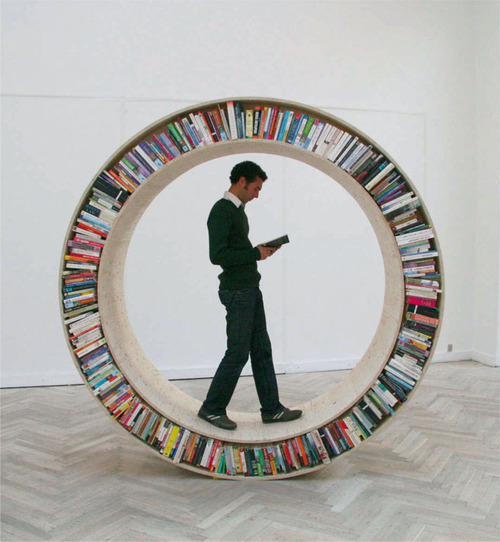 |
| I want one. |
Subscribe to:
Posts (Atom)