6.09.2013

Book Sale

Every summer the Bloomington Crime Prevention Association has its Book 'Em Annual Book Sale. And, every year I buy all sorts of books at the sale...it is a gold mine of used books. I spent a few hours and $48.00 to obtain the following books:

  • God Save this Honorable Court: How the Choice of Supreme Court Justices Shapes Our History by Lawrence H. Tribe (brilliant scholar in the Harvard Law school) 
  • Gone for Soldiers: A Novel of the Mexican War by Jeff Shaara (I read him and his dad)
  • We were Dreamers by Jim Lehrer (ex-columnist turned novelist)
  • The Whore's Child and Other Stories and Empire Falls, both by Richard Russo (the latter I already read, but the opportunity for a first edition was too much to pass up)
  • Rabbit at Rest by John Updike
  • Ford County: Stories by John Grisham (he spins a great yarn)
  • The Last Judgement by Iain Pears (already read it..first edition)
  • Pet Sematary and The Green Mile Part 2: The Mouse on the Mile by Stephen King (I have been reading him forever and continue to add first editions to the collection)
  • Zero History by William Gibson (I never understand him, but continue to read his stuff)
  • The Echo of Greece by Edith Hamilton (she is almost as cool as Joseph Campbell)
  • Good Enough to Dream by Roger Kahn (I never pass up a chance to read about baseball, especially during the summer)
  • True Notebooks by Mark Salzman (another first edition and another author I love)
  • The Eight by Katherine Neville (I loved this book when I read it over 10 years ago)
  • Nixon: The Education of a Politician 1913–1962 by Stephen E. Ambrose (he brings history to life for a lot of people, and I have been wanting to read this one for a while now)
  • I Love You, Beth Cooper by Larry Doyle (any book with endorsements from Tom Perrotta and Dave Barry must be good)
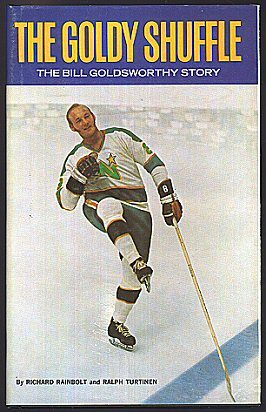
  • The Goldy Shuffle: The Bill Goldsworthy Story by Richard Rainbolt and Ralph Turtinen (he was a Minnesota North Star...'buff said)
I also picked up a couple of the Norton Critical Editions and Scribners, as well as five green Penguin books that I collect.

Not a bad outing at all.

5.05.2013

Advice for Undergraduates

Harvard-Bound? Chin Up

By DAVID BROOKS
Op-Ed Columnist
March 2, 2006

I've got great news! You're young and you're smart and next year
you're beginning college. Unfortunately, I've also got bad news.
The only school you got into is Harvard, where, as Peter Beinart of
The New Republic notes, students often graduate
"without the kind of core knowledge that you'd
expect from a good high school student,"
and required courses can be
"a hodgepodge of arbitrary, esoteric classes
that cohere into nothing at all."
But don't despair. I've consulted with a bevy of sages, and I've
come up with a list. If you do everything on this list, you'll get
a great education, no matter what college you attend:


Read Reinhold Niebuhr. Religion is a crucial driving force of this
century, and Niebuhr is the wisest guide. As Alan Wolfe of Boston
College notes, if everyone read Niebuhr,
“The devout would learn that public piety corrupts private faith and that faith
must play a prophetic role in society. The atheists would learn that some people
who believe in God are really, really smart. All of them would learn that good
and evil really do exist ? and that it is never as easy as it seems to know which
is which. And none of them, so long as they absorbed what they were reading,
could believe that the best way to divide opinion is between liberals on the one
hand and conservatives on the other.”

Read Plato's “Gorgias.” As Robert George of Princeton observes,
“The explicit point of the dialogue is to demonstrate the superiority of philosophy
(the quest for wisdom and truth) to rhetoric (the art of persuasion in the cause of
victory). At a deeper level, it teaches that the worldly honors that one may win by
being a good speaker...can all too easily erode one's devotion to truth? A devotion
that is critical to our integrity as persons. So rhetorical skills are dangerous,
potentially soul-imperiling, gifts.”
Explains everything you need to know about politics and punditry.

Take a course on ancient Greece. For 2,500 years, educators knew
that the core of their mission was to bring students into contact
with heroes like Pericles, Socrates and Leonidas.
“No habit is so
important to acquire,”
Aristotle wrote, as the ability
“to delight
in fine characters and
noble actions."
Alfred North Whitehead agreed, saying,
“Moral education is
impossible without the habitual
vision of greatness.”


That core educational principle was abandoned about a generation
ago, during a spasm of radical egalitarianism. And once that
principle was lost, the entire coherence of higher education was
lost with it. So now you've got to find your own ways to learn
about history's heroes, the figures who will serve as models to
emulate and who will provide you with standards to use to measure
your own conduct. Remember, as the British educator Richard
Livingstone once wrote,
“One is apt to think of moral failure as due to weakness
of character: more often it is due to an inadequate ideal.”

Learn a foreign language. The biographer Ron Chernow observes,
“My impression is that many students have turned into
cunning little careerists, jockeying for advancement.”
To counteract this, he suggests taking “wildly impractical” courses like
art history and Elizabethan drama.
“They should especially try to master a foreign language as a way to annex another
culture and discover unseen sides to themselves. As we have evolved into a matchless
global power, we have simply become provincial on an ever larger stage.”

Spend a year abroad. Shibley Telhami of the University of Maryland
believes that all major universities should require a year abroad:
“All evidence suggests this, more than any other, is a
transforming experience for students that lasts a lifetime.”

Take a course in neuroscience. In the next 50 years, half the
explanations you hear for human behavior are going to involve brain
structure and function. You've got to know which are serious and
which are cockamamie.

Take statistics. Sorry, but you'll find later in life that it's
handy to know what a standard deviation is.

Forget about your career for once in your life. This was the core
message from everyone I contacted. Raised to be workaholics,
students today have developed a
“carapace, an enveloping shell that hinders them from
seeing the full, rich variety of intellectual and practical opportunities
offered by the world,”
observes Charles Hill of Yale. You've got to burst out of that narrow
careerist mentality. Of course, it will be hard when you're
surrounded by so many narrow careerist professors building their
little subdisciplinary empires.

But you can do it. I have faith.


2.07.2013

ggplot Valentine's Day Theme

I wrote an R package to apply a Valentine's Day theme to plots created with ggplot. It includes a color palette based on the colors of candy hearts which can be used with the custom scale_color_valentine() and scale_fill_valentine() functions. It also features two custom fonts that apply sweet title stylings and flirty text throughout the plot.

The package is available from github at https://github.com/zief0002/Valentine


1.13.2013

Running

Throughout my life I have had a love/hate relationship with running. In more recent years this has trended toward hate. High school was easily the pinnacle of the "love" side of the spectrum, which also extended into college. (It is amazing how this also corresponds to the time in my life when I weighed ~125lbs.) Since then, I can honestly say the results of running I definitely love, while the act itself is tantamount to fingernails on a chalkboard.

In the 9th grade, I was suckered into joining the track team by my friend Josh Davis. It seemed like a great idea. I would spend afternoons with friends, and I was pretty fast. What could running a few sprints hurt? After about two days of working with the sprinters, it was clear that I didn't have the short-twitch muscle structure to be a viable sprinter. It was then I was "traded" to Coach Domek and the middle/long distance runners.
Apollo High School Track & Field Team; 1989-1990
My Track Photo; 1989-1990

Talk about hurt. Every workout sucked. Ladders. Sowbellys. Long runs. Fartleks. Horrible. I have never in my life experienced a runner's high. At best, there was a time when I could put my mind in a different place and not really feel anything. Most of the time it was just anguish to me. By the end of that first year, I was a miler and had run my first sub seven minute mile. (This is not good.) By the middle of my second season I was running the mile in the 4:50s (this was good, but at the time we had three other runners faster than that). I quit in the middle of that season because of consistent, recurring  shin splints (there was actually a fissure in my tibia).

That next fall I was talked into joining the cross country team–like track except longer runs and races were on a field (often a golf course) rather than the track. Cross country was more fun than track. The head coach had a different personality than the track coach, which made things better. Also, running on the grass was much easier on my legs. In the three years I ran cross country I was never great. I think I ran my best 5k in about 17:40(ish), which again was good, but not even close to the top runners.

Apollo High School Cross Country Team; 1991-1992
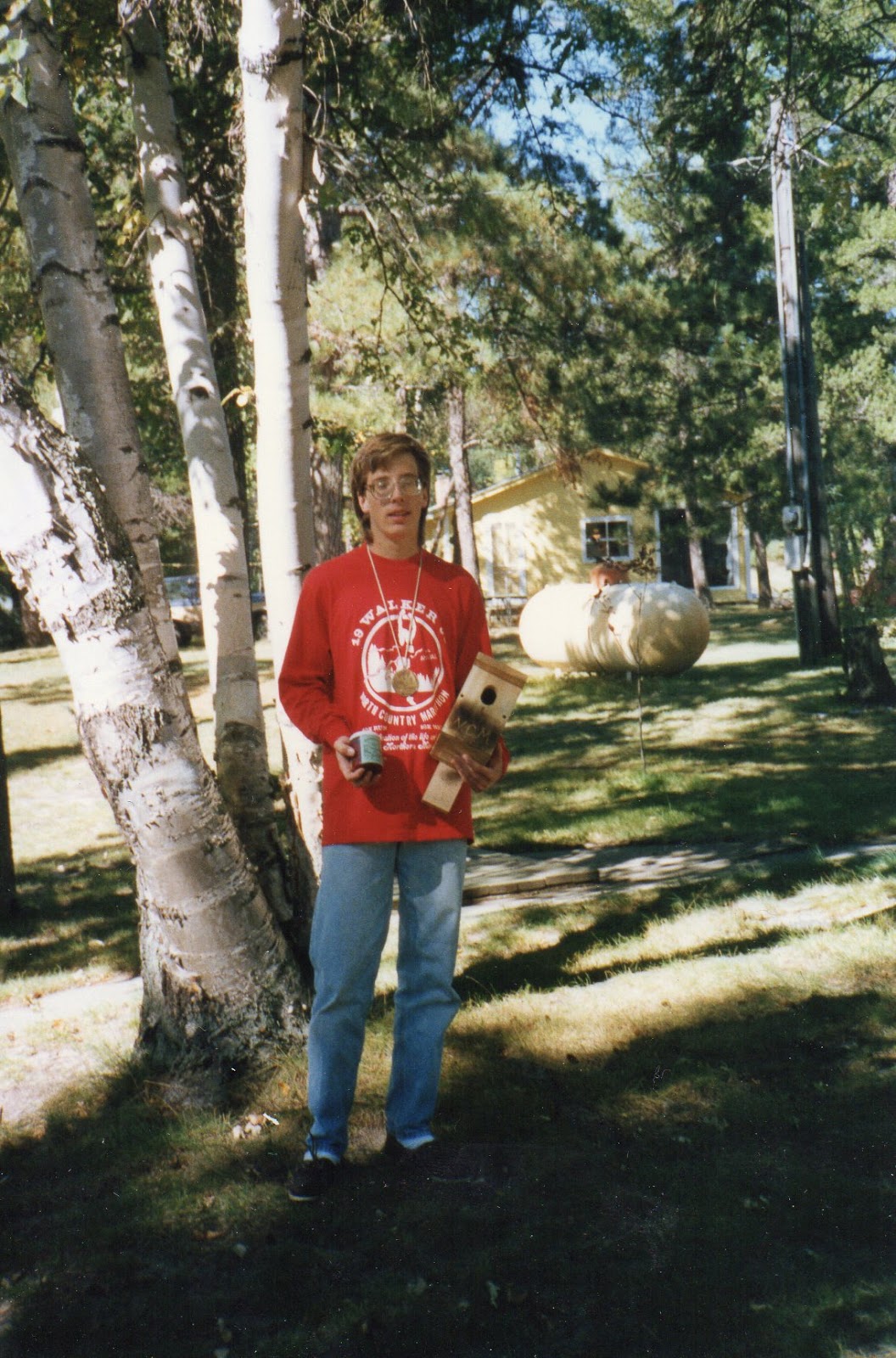
I never ran on an organized team after high school. I have run some races since those days, generally doing pretty well in my age group. One year I ran the North Country 10k in Walker, MN. I won my age group and as a prize I was given a bird house and a jar of jam. 


In summer 1997, I ran my last races (most likely forever). My buddy Josh Davis, who I mentioned earlier, were both working at the YMCA in St. Cloud that summer, and we decided to get into really great shape. In addition to lifting huge weights on a daily basis (and quoting the movie Pumping Iron while we did that), we also decided to begin a running routine. To make sure we followed through with this, we also signed up for 3 races (a 10k, 5k and 1-mile). 

I won my age group for the last two of those. The 5k was the absolute worst. We were both hung over and I don't know how either one of us made it through that race. The one-mile race was in St. Paul, and after we ran that race we had to walk back to our car (we had stupidly parked near the starting line). En-route back to the car, a parade was passing by and Norm Coleman waved at us. We both waved back and then gave him the finger. 

Digital Scrapbook: Class Pictures

Row 1: Jon, Daniel Schultz, Linda Klug, Andrew Zieffler, Nissa, Becky Gully, Joelle Anderson, Kayla Hoeschen
Row 2: Jean Jordan, Nicole Schoenberg, Kristen Betterman, Mike Mullen, Robin G., Ricky, Kira Camp,
Chad Brommenschenkel, Tara Nydeen
Row 3: Mrs. Moilanen, Mike Talbot, Paul Jacobs, Kevin Loke, Shannon, Tony Neu, Angela M., Sharon Kline, Tony Hatton, David Butzlaf, Carl Stut, Mrs. Erickson  


Mr Werschay's Grade 7 Social Studies Class; 1986-1987
As I look at the Kindergarten picture, it occurs to me that any of those outfits are Hipster chic currently.

Although I have spotty memories from this era (playing hockey with Tony Hatten, Joel Lieser and Bob Hess; programming and playing Apple IIe games with Paul Jacobs) the person that I spent the most time with through the Westwood years was Jean Jordan.

Jean and I were always in the advanced groups in reading and math and spent a lot of time just hanging out playing with Cabbage Patch Kids, trading stickers and Garbage Pail Kid cards. You can also see the slide in the 3rd Grade pic (left-hand side) that we used to hold hands near. It was heart-breaking for both of us after 6th grade when she went to Technical High School and I went to Apollo High School.

Jean went on to an acting career and was a pioneer in reality television [read her post-house interview at Salon.com]. I have never watched Big Brother and didn't find out until many years after her appearance that she was even on the show. It is unfortunate that most of America only knows her from this (what I can only imagine is a) mind-numbing television show. Jean was one of the most caring, sweet, sharp people I knew. Wherever you are Jean, and whatever you are doing, know that I will always remember our time together learning multiplication of numbers with two digits and you will forever be a Westwood Wildcat.

1.11.2013

Trafficking White Powder

I have a friend who works at Bay State Milling coordinating the transportation of flour. (This makes him super-cool because he works at a place that is essential to toast production.) The following YouTube video gives a sneak-peek into the very operations used to make flour that then eventually become the sweetest ambrosia to grace out taste buds....toast.


1.06.2013

Funny Stuff:2012

Here is some of the funnier stuff I saw or received in 2012

This made me laugh because our research group is called Catalysts and I think we all felt like we needed mental help.

I saw this near the 1st floor bathroom in what was formerly Oak City Grill.

I saw this outside of Elliott Hall (the Psychology building) on campus. 

At the Nomad. A national competition like air guitar...but with orgasms.

In the Minneapolis Star Tribune...do I need to say anything?

Again, seen in front of Elliott Hall. The funny thing is one of the slips has been taken!

Sent to me via email. Love it.

Hear! Hear!

Ok..I didn't see this in 2012, but I did see it in 2007 in Wilson Library at the University of Minnesota. It is too much that the call letters for the Bible is BS. Awesome!

12.31.2012

Outsourced Resolutions

It is almost time to set resolutions for the new year. Before doing so, however, one needs to review the current year's resolutions for posterity. I didn't set any resolutions for myself in 2012, but I did set some resolutions for my friend Sherri (she outsourced her resolutions to me last January).


I will check in tonight with Sherri to see how resolved any of these may have been. I hope she learned Swedish Chef!

Digital Scrapbook: Halloween

Halloween is a holiday that is enjoyed best when you are younger. I remember going to the store (Shopko usually) to pick out Halloween costumes a coupe times, but in general we created our own. We always carved at least one Jack-O-Lantern. Although Sandra and I would go trick-or-treating, most of the candy got thrown out because we wouldn't eat it. I think Fritz ate more of it than us. Below is a sample of the pics that are in the slideshow [click here].

Halloween 1976

Halloween 1983

12.30.2012

We Start 'Em Young in Minnesota

I apparently started drinking coffee and shoveling snow at a young age. It must have took...I still do both.

Fritz and Andy drinking joe in 1976.

Andy cleans the driveway (Spring, 1976).

With the size of that shovel, this must have taken all day.

Digital Scrapbook: Squawker & Pecker

Some time ago my sister and I reared two ducklings to adulthood after their mother and siblings were annihilated from the planet by a mean retriever. I named my duck Squawker and Sandra named her duck Pecker. For awhile they lived in a box in the kitchen (St. Cloud) or living room (Hackensack)-and occasionally in our caps, but as they got bigger (later in the summer) they were relegated to a "pen" made of railroad ties that Fritz built next to the garage. By the end of that summer, they had flown out of the pen and lived in Pleasant Lake. Those ducks not only survived, but we are pretty convinced that they came back with their families (year after year) and basked on the dock (much to Fritz's chagrin).

Squawker and Pecker in the kitchen.

Andy (w/Squawker) and Sandra (w/Pecker) in
the living room in Hackensack.

In the pen.
See all the pics in the "Squawker and Pecker" Flickr set [click here].

12.28.2012

Digital Scrapbook: Fritz Retires from Teaching

My dad taught math at Sartell High School for many years. Here is the article in the Sartell High School newspaper from when he retired.


12.25.2012

Digital Scrapbook: Fritz is a Bug Farmer

My dad, Fritz, farmed bugs for several years. He would raise these bugs (in fact, I think he got some funding from the government to do this), then they would turn them loose to combat Purple Loosestrife. Here is the cover story from the Hackensack paper.


12.21.2012

Digital Scrapbook: Jason Koets

Jason Koets was one of the first people I met when I started teaching at ROCORI. He was hired the same year I was to direct the ROCRI High School band. We had a lot of fun.


Digital Scrapbook: My Great Aunt–Daisey

My great aunt, Daisey, henceforth Aunt Daisey or as we called her "Aunt Da" (pronounced Day), was a high school english teacher at Bemidji High School (she taught there for 36 years). She was in large part a hero of mine growing up. She competed in the New York Times crossword puzzle challenges and could complete those buggers faster than anyone I knew. I remember distinctly sitting on her lap and getting my first clue correct. I was hooked from then on.

Aunt Daisey had  both bachelor's and master's degrees in English Education (University of North Dakota). She would recite Shakespeare to my sister and I, entire plays, from memory doing different voices for each of the characters. My favorite was the opening of Macbeth with the witches. She also loved poetry giving living room performances of Tennyson as the mood struck.

Aunt Da never married and never had kids. She was a diehard Republican, not missing a caucus in several decades and a chair of the Beltrami County Republican Party. She was a member of the American Assoication of University Women and was elected president of the Minnesota Educators Association. Everybody in Bemidji seemed to know her.


This column appeared in the Bemidji newspaper after Aunt Da's memorial service. 

    Last weekend I attended a memorial service for an old friend and mentor, Daisey Norgart. Daisey had been my supervising teacher when I student taught at Bemidji High School back in fall of 1974. She was a small lady with a raspy voice, sparkling eyes, an unmistakable laugh and a reputation of legendary proportion.
    Small in stature, but larger than life, Daisey loomed as the epitome of English teachers. She was demanding, hard working, and often set in her ways, but few if any of the students who had Daisey as a teacher left her classroom without learning something. She taught me many things that I know to be as true today as they were back in 1974. Here are a few of the lessons taught to a naive young student teacher:
    Set high expectations for students. Daisey let her students know what was expected. Her students knew there would be no free time and that a lack of preparation for class would not be tolerated, that no matter how good you thought you were, she could find ways to make you work harder and better.
    Once you've set high expectations, stick to them. Daisey demanded a lot of her students. Illegible papers with unclipped edges certainly didn't make even the first cut. Papers that lacked organization or original thoughts didn't go far either. Undone assignments were unheard of if a student hoped to pass Daisey's class. And classroom behavior had to be conducive to good learning for everyone in the room.
    Model what you want students to learn, and give them time to practice. In recent education classes I've taken, terms like "Lesson Design," "Motivation Theory," and "Practice Theory" fit Daisey's style to a "T." Daisey demonstrated grammatical rules to her students and they practiced them until what used to sound all right to them, but wasn't, finally was corrected in accordance to the Queen's English. If you didn't know when to use "who" and when to use "whom" before you came to class, you certainly would know it when you left.
    Let your love of the subject and your feelings of its importance come across. Daisey allowed me to teach her advanced composition classes, I believe, because she knew that my love of writing would transfer to the students, but she kept the English Literature class to herself. A teacher can teach best that which she finds engrossing, precious, necessary, and utterly important. Without a passion for teaching,it is impossible to expect a passion for learning.
    Although I adopted my own style of teaching and my own passions, I learned a great deal from Daisey, some of which didn't even click with me until I sat there on Saturday and listened to other cohorts speak of her style, her professionalism, her dedication to teaching.
    She taught English at Bemidji High School for 36 years and touched the lives of thousands of students, most of whom still have a clearer picture of this dynamic, demanding little lady than of most of their former teachers. Some might describe her as eccentric, but no one doubted her understanding of what she taught and her ability to make students learn. She didn't set out to win popularity contests, yet she was a frequently requested teacher for students who wanted to be well-prepared for college. 
    Farewell Daisey, and thank you. I picture you staking out your own chair in the hereafter and making those spirits about you mind their p's and q's.


Sue Bruns taught English at Bemidji High School from 1977-98. For the past three years she has served as the graduation standards technician for Bemidji High School. This column is provided by the Bemidji Education Association.